
The Hidden Costs of Cross-Plan Offsetting for Self-Funded Plans
- Dec 18, 2025
- 3 min read
Introduction
Cross-plan offsetting — also known as bulk recovery — is marketed by carriers as an efficient way to recoup provider overpayments. But beneath the surface, this practice exposes self-funded plans to hidden costs, fiduciary risks, and compliance challenges that plan sponsors cannot afford to overlook.
How Cross-Plan Offsetting Works: Promise vs. Reality
UHC reported recovering nearly $922 million for self-funded customers in 2022.
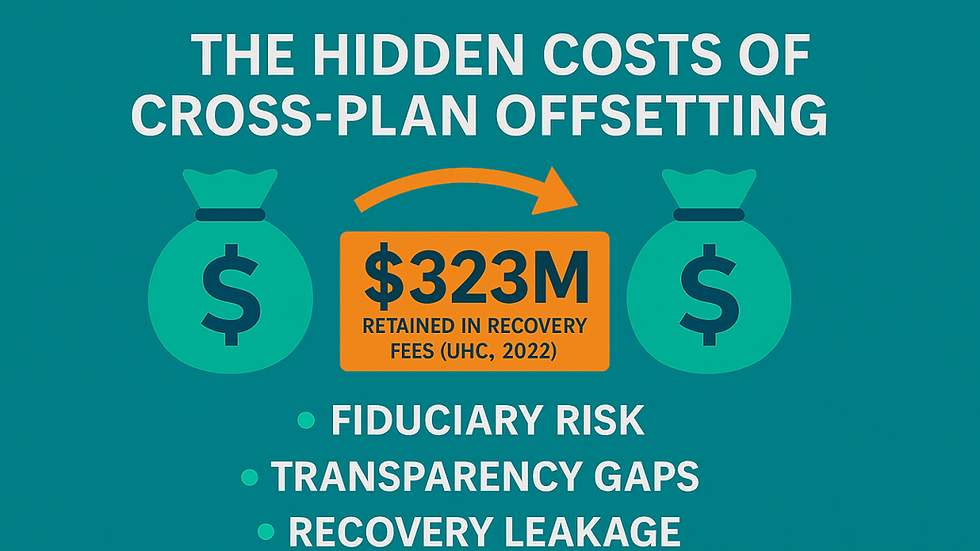
What they don't highlight: UHC keeps 25–35% of recovered dollars — as much as $323M siphoned from plan assets.
These are bulk cross-plan recoveries only and do not include one-off recoveries or settlements.
Overpayments can be offset across different plans, exposing members to balance billing and disputes.
📎 You can find the source publication from UHC here.
The Self-Admitted 1.4% Problem
UHC admits that 1.4% of claims are processed improperly and are routed to recovery.
Yet their ASO contracts guarantee 99% processing accuracy.
How can both be true? A 1% margin of error under ASO guarantees vs. a 1.4% error rate feeding recoveries means administrators are monetizing their own mistakes.
Compounding this: not all recoveries are successful, meaning some plan dollars are permanently lost — while carriers still take their fee.
Fiduciary Risks of Cross-Plan Offsetting
Conflicts of Interest: Recovery fees create incentives for administrators to profit from errors.
Transparency Gaps: Public reporting omits what administrators keep.
Recovery Dependence: Plans tied into bulk recovery risk litigation, leakage, and fiduciary exposure.
The ClaimInformatics Perspective
We help fiduciaries protect plan assets by:
Reviewing recovery practices — including cross-plan offsetting arrangements — for ERISA compliance.
Verifying credits to ensure your plan isn't subsidizing others.
Uncovering leakage from delayed or missed recoveries.
Providing independent oversight beyond carrier reporting.
Frequently Asked Questions
What is cross-plan offsetting? Cross-plan offsetting (or bulk recovery) is a practice where carriers recover overpayments from providers by applying credits across multiple health plans, rather than tracking recoveries to individual plans.
Why is cross-plan offsetting a fiduciary concern? Under ERISA, plan sponsors have a fiduciary duty to ensure plan assets benefit only plan participants. When recoveries are pooled across plans, sponsors cannot verify their plan received appropriate credits.
How much do carriers keep from cross-plan offsetting recoveries? Carriers typically retain 25–35% of recovered dollars as fees. On $922 million in recoveries, this could mean over $300 million diverted from plan assets.
How can plan sponsors protect themselves from bulk recovery risks? Sponsors should request detailed recovery reporting, engage independent claims auditors, and review ASO contracts for transparency provisions around cross-plan offsetting practices.
Bottom Line
Cross-plan offsetting may appear efficient, but without transparency and independent oversight, it creates fiduciary and financial risks that no plan sponsor can afford to ignore.
📩 Contact ClaimInformatics for a complimentary review of your plan's recovery practices.
Related Resources from ClaimInformatics
What's your experience with carrier recovery practices? Share in the comments!


Comments